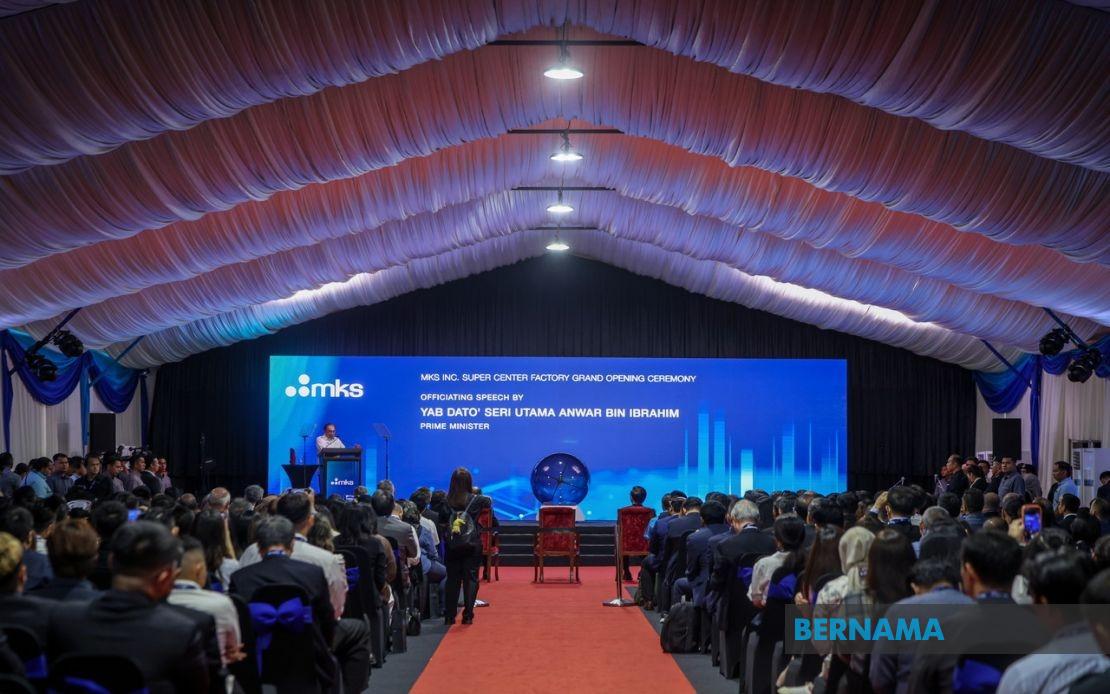
Prime Minister Datuk Seri Anwar Ibrahim has positioned Malaysia's non-aligned foreign policy as a strategic economic asset, arguing that the nation's commitment to engaging countries across competing geopolitical blocs while preserving its sovereign independence has strengthened global investor confidence and opened new avenues for bilateral cooperation. Speaking at the opening of MKS Super Centre's manufacturing facility in Bandar Cassia Technology Park here, the Prime Minister underscored how this diplomatic balancing act translates into tangible commercial gains, citing recent energy sector agreements as evidence of the approach's practical benefits.
The Prime Minister's remarks reflect a deliberate effort to position Malaysia as a trustworthy intermediary in an increasingly fractured global order. By maintaining equidistance from competing powers, Malaysia has managed to establish productive relationships with the United States, China, India, and Russia simultaneously—a feat that few nations of comparable size have achieved. This diplomatic positioning is particularly valuable in Southeast Asia, where smaller nations often struggle to navigate the rising tensions between major powers seeking regional influence and alignment.
Anwar's reference to President Donald Trump's visit, which occurred during the previous year, alongside recent engagements with the Russian Federation, illustrates how Malaysia has managed relationships with ideologically divergent partners. The administration has deliberately avoided taking rigid positions that would alienate any major economic player, instead emphasizing Malaysia's willingness to cooperate on mutually beneficial terms regardless of broader geopolitical tensions elsewhere.
The economic dividends of this strategy are becoming increasingly visible. Petronas, Malaysia's national oil and gas corporation, has successfully negotiated agreements in Turkmenistan, demonstrating how Malaysia's neutral stance facilitates energy sector partnerships that might otherwise face complications in the current global climate. These deals represent not merely financial transactions but reflect international confidence in Malaysia's reliability as a stable, non-ideological partner capable of managing complex commercial relationships despite external pressures.
The Prime Minister's emphasis on Malaysia's "centrality" reveals a strategic calculation about the nation's future role in Asia-Pacific affairs. As major powers compete for influence and market access across the region, countries that maintain principled independence while remaining open to engagement become increasingly valuable as both economic partners and diplomatic interlocutors. Malaysia's ability to articulate its own positions on contentious international issues while simultaneously welcoming participation from all interested parties suggests a maturity in diplomatic conduct that reassures investors seeking stability.
This approach carries particular significance for Malaysian business communities and investors seeking to expand internationally. When the national government maintains strong relationships across competing blocs, Malaysian companies gain preferential access to markets and partnerships that might otherwise be fragmented by geopolitical tensions. Companies operating in sectors ranging from energy to manufacturing benefit from the diplomatic environment their government creates, as reduced friction translates into smoother regulatory processes and stronger commercial terms.
The gathering at the MKS factory opening, which included Penang Chief Minister Chow Kon Yeow and Deputy Minister of Investment, Trade and Industry Sim Tze Tzin, underscores how Malaysia's foreign policy framework extends into the domestic economy. Penang's status as a major manufacturing and technology hub depends partly on the predictable, investment-friendly environment created by consistent non-aligned foreign policy. When international investors see that Malaysia maintains stable, pragmatic relationships with multiple power centers, they gain confidence that regulatory environments and trade access will remain stable regardless of which global power ascends or declines.
The non-aligned positioning also allows Malaysia to exercise greater voice in international forums without appearing captive to any single power's agenda. When Malaysia advocates for specific positions—whether on climate issues, maritime disputes, or international trade—the nation's perceived independence lends greater weight to those arguments. This moral and diplomatic authority becomes increasingly valuable as global governance challenges multiply and require coalitions willing to advance solutions rather than merely serve particular powers' interests.
From a Southeast Asian perspective, Malaysia's approach offers lessons about maintaining agency in a region increasingly claimed by competing powers. Vietnam, Indonesia, and Thailand pursue broadly similar strategies of balanced engagement, but Malaysia's explicit articulation of this principle—and its demonstrated economic success under this framework—may strengthen regional commitment to non-alignment. A ASEAN characterized by member states pursuing independent, pragmatic foreign policies remains far more resilient than one divided into competing camps aligned with external powers.
The timing of Anwar's remarks carries significance given ongoing global realignments, including shifts in US Asia policy, evolving US-China competition, and Russia's ongoing international isolation following its 2022 invasion of Ukraine. By reaffirming Malaysia's openness to engagement with Russia despite Western sanctions and diplomatic pressure, the Prime Minister signals that Malaysia will not subordinate its foreign policy to external pressure from any quarter—a posture that enhances the nation's credibility among countries seeking alternatives to great power alignment.
Looking forward, Malaysia's non-aligned strategy likely becomes increasingly valuable as global supply chains diversify away from concentration in single jurisdictions and geopolitical blocs. Companies seeking to distribute manufacturing, energy, and logistics operations across stable, reliable partners will find Malaysia's positioning particularly attractive. The nation's geographic location, relatively developed infrastructure, skilled workforce, and diplomatic stability create a compelling value proposition enhanced considerably by government relationships spanning the full spectrum of major global powers.